
Welcome to Slow Comms
A newsletter about ambling through the deeply satisfying work of communicating on behalf of others while an entire culture tells you to hurry up

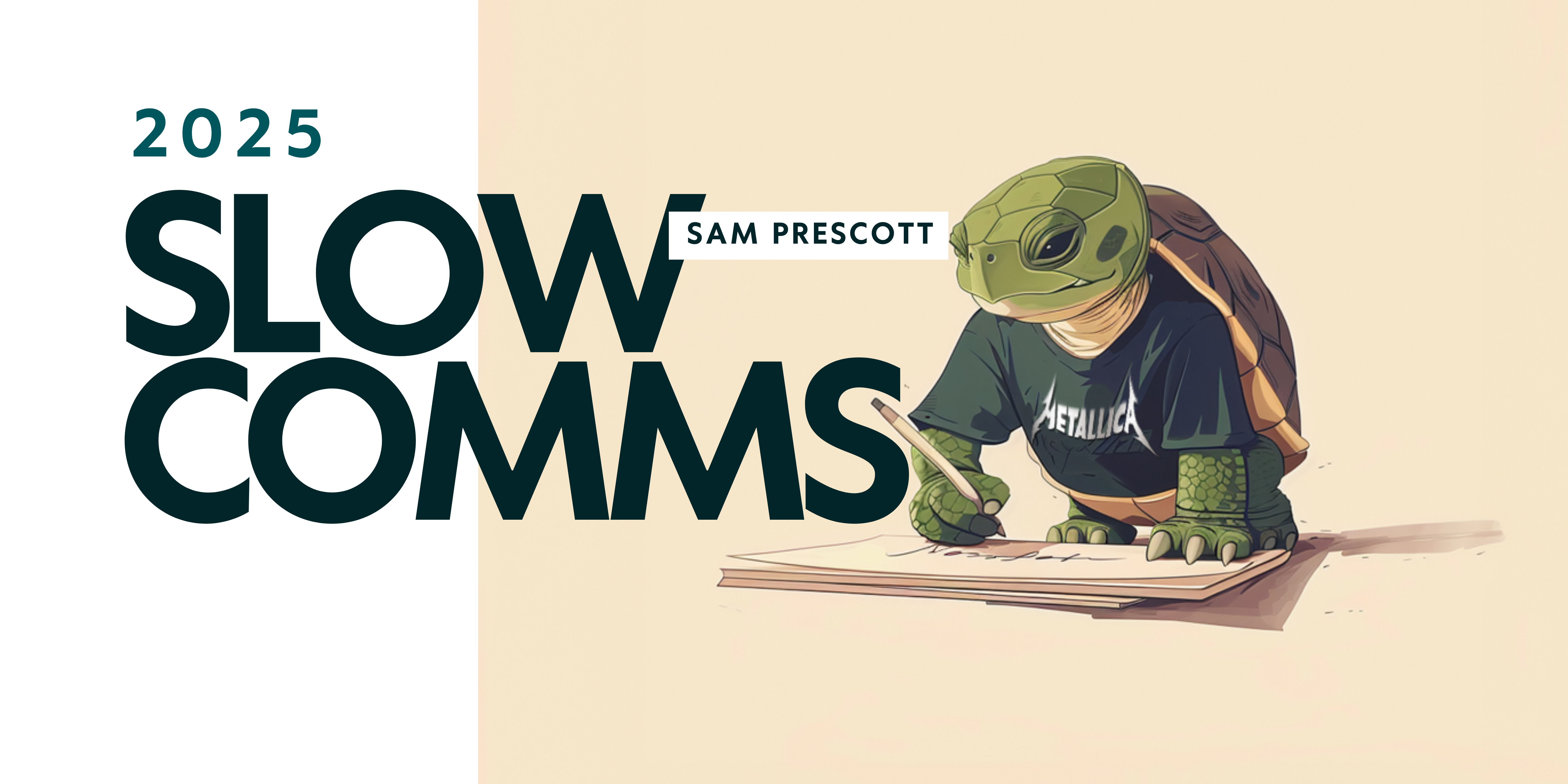
Title alternatives I shelved: Introducing Friction, Always Read the Comments, Dab of Grit, Intellectual Anaesthesia, Let the Pig Out of the Sack.
I went with Slow Comms following a long conversation with an old friend in a similar kind of work, in which some of the ideas above - the scourge of frictionlessness, letting pigs out of sacks - kept us talking long after we should have stopped and gone back to our real jobs.
We took “too long” maybe, but I’ll tell you this: it was one of the most satisfying and connected conversations about work I’ve had in ages.
Intellectual anaesthesia was actually her term (I’d have used it as a newsletter title with her permission) describing a deadening of our interactions with media texts, other primary vectors of cultural production, and the world in general. But also: each other.
This, she reasoned, was a result of a lack of friction. This is the same friction we have demonised in every facet of modern life, in exaltation of that which is frictionless. Now, everything must come flying at us, atomising defences as it crashes through, causing fragmentation and confusion as we work to absorb all this stimulus.
Swipe, scroll, click agree.
Many of us, bent under the weight of the modern communications mix, this wide net of message delivery in which we are all tangled, bottom trawled, scraped off of our selves… just want a little peace.
Intellectual anaesthesia is the result - it’s the cause and the spurious cure.
Slow As
The slow movement hit food, latterly fashion, art of all kinds… almost any area of human creative endeavour (gee, I wonder why). I’ve never heard of slow HVAC repair, but, hey, maybe all those tradies making us wait half a day to fume at how they’re late for half a day only to arrive the next day all knew something we didn’t.
Slow Comms is a way of making sense of how we navigate the complex systems of communications and PR in the mid-2020s and beyond. I think it’s time, really, for a slow communications movement. But you know what? It’s not possible to just decide that.
Movements are organic: you don’t start them, you don’t end them. They’re too human for manipulation (unlike most of the tools brandished as weapons in the antithesis of slow communications). Movements appear in communities, because communities are organic too; often the result of responses to inorganic stimulus - a sense that something in the environment is alien or wrong.
So, this is a tiny scrap of sediment carried in what’s a disconnected torrent; over time, maybe we’ll coalesce, and pretty soon we’ll have something solid forming.
Decalcify softly, but carry a big rhetorical killbox
I’ve said for a while that myths don’t bust. “Bust” being kind of semiotically loaded - something that’s there one second and then, boom, gone the next.
Myths aren’t like that.
They can’t bust because they don’t form spontaneously and are therefore not insubstantial structures - myths are story, and story is human, and we are products of evolution. Our stories are STRONG.
The evolutionary message- and meaning-making process might happen on a much smaller scale to develop a myth about, say, vaccines causing autism - but it still requires layers to stack and harden.
A reverse approach is required to tackling myth; our clients can say, “We’re gonna bust some myths!” until they’re blue in their adorable faces, but, no. They’re not.
What they might be able to do with slow comms is start to rub them away.
This means injecting nuance, and driving for specificity. These are two things that have been largely juiced out of our discourse.
Last week I was in touch (email initiated by me) with Dr Kyle Matthews, a research fellow at He Whenua Taurikura, the National Centre of Research Excellence for Preventing and Countering Violent Extremism, at Te Herenga Waka Victoria University of Wellington. He wrote an article in the Spinoff (his first as far as I can tell) that I loved for two reasons -
He could have howled about this on Bluesky, had it algo-assassinated on LinkedIn or made a 30 second Insta reel venting his spleen, but he didn’t. He went looong-form.
The piece isn’t an opinion, as much as it is a deconstruction.
He looked at the build up of myth that had surrounded InternetNZ (read the article if you’re interested in the full facts of it, but this is about style and structure, not content) and pulled it apart, rendering down the arguments made by the organisation’s detractors.
He drew on the concept of cultural signifiers, and put in some real elbow-grease to isolate and attack each one. He started to decalcify the hard buildup of myth, realising no doubt (I didn’t ask him, but I’m not a journalist so call the cops IDGAF) that his was one contribution in what would probably have to be a torrent of many.
The main thing I took away was this: in Dr Matthew’s rhetorical killbox, he went deep. And deep is slow.
This is the kind of communicating that really makes a difference.
Gen AI’s sedimentary layers
There’s already a buildup of bullshit as a result of the generative AI “revolution”.
You can’t get a straight number on this, but masses of social media content is now AI generated - meaning, generated from human prompts, but where the text, images, etc are probabilistically decided by AI.
There’s a really important piece of language that ought to stop too many of us (professional communicators) getting too excited about the outer limits of this technology’s capabilities - at least in terms of replacing complex human action and reaction in our sector.
Said language, is GENERATIVE. This thing can generate new words and images, but it can’t create them. There’s an important distinction and if you’ve read this far in my first-issue wall of text, I’m going to assume you know it.
THIS is why I think social media and the entire, modern, hectically social-first communications system we have built is under threat of collapse. Generative AI will cost the sector and related sectors jobs, but not for the reasons most people think.
This isn’t about replacing US, it’s about replacing our audience, and, (allowing for the already prevalent, unchecked and catastrophic algorithmic global psy-op) replacing our real stuff with… crap.
The system is optimised to upweight the dross and kill off any real connection. Real connection is the only true way of sending an authentic electrical impulse across the ether - it’s the only faithful message delivery there is. Real connection equals contextual relevance, but it’s being allowed to happen online less and less.
People are already sensing this; engagement is down. Organisations are starting to abandon certain platforms (sometimes announced on LinkedIn). It feels like the ecosystem is under threat, which naturally causes a (sensible) retreat.
The current system is deliberately and mendaciously not designed for real connection. It’s not designed for contextual relevance. Maybe it was once, but not anymore.
And we paid for it by dismantling and selling off many of the systems that had previously worked pretty well. So, we need to build a new one. And it’s probably (necessarily) going to have a lot of hollowed out and dusty remnants of the old one.
Slow Comms is all about that looming change.
Let the pig out of the sack
I won’t have a lot of pictures or links or multimedia in this newsletter, because, I don’t really know how to make that stuff or make best use of it. I’m a words guy.
Engaging with this writing and the ideas in it (my ideas) is always going to be an exercise (for you and for me) in slowing down and digesting, because, I often write like I think.
These ideas will often have their bedrock in traditional communications and public relations principles.
Perhaps just as often, they’ll be about what I think is wrong in the modern communications mix, and how we can make it right.
“Content” (ugh) is really only three things: text, audio and images (moving or still). I’m obviously picking one of those and running with it.
Content development really only fits into three categories: meditation, lamentation, celebration.
I’m can be a bit of a cynic, so maybe we’ll do more lamenting than celebrating, but I tried to ensure that this first crack at Slow Comms had all three.
Let the pig out of the sack.
-Sam.